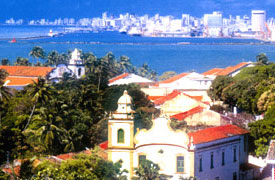
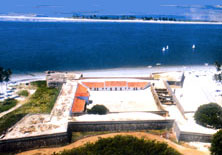
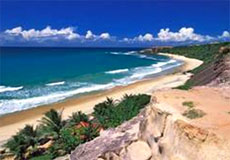
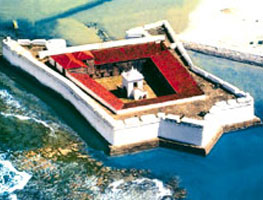
Duarte Coelho found a strategically place to install, in the high hills, the village that became Olinda. In 1637, Maurício de Nassau assumes the government. Cult, Nassau leads an urbanity revolution in the city: streets and several bridges were constructed. Visit to the city, including the beach, Boa Viagem church, the Capibaribe and Beberibe Rivers and the Golden Chapel. Trip to the Five Points Fort, streets Sol and Aurora (Old Recife), Brum Fort, Pátio de St. Pedro, Campo das Princesas, the Maurício de Nassau Bridge (the oldest in Brazil). Visit to the city of Olinda - Historic and artistic monument (said title awarded by UNESCO), the Heights and church da Sé (1537), the old slave market, the steep streets and convent of St. Francisco (1585).
Day 2. (Mon) - Olinda / Igarassu / Itamaracá.
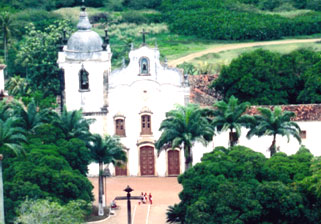
Visit Igarassu, cradle of the state’s history (1535), We will find roughly stoned streets, simple rows of houses, ancient ingenuities, and religious buildings, such as the church of the Saints Cosme and Damião (1535 – the oldest in Brazil) and the Convent of Santo Antônio, home of the gallery most representative of colonial art. Igarassu, 39km from Recife, located in the region where the first exploration during the Portuguese colonization took place. It is notable for its religious festivals, such as the Buscada (search) de St. Gonçalo do Amarante. We will visit the famous Itamaracá Island and the Orange Fort, from where we can cross over to Coroa do Avião to enjoy bathing sports and delicious seafood.
Day 3. (Tues) – Itamaracá / Goiana.
After breakfast raft to the natural pools at Pedra da Galé, formed in the coral reefs which divide the open sea from the soft calm waters, where you will have the chance to feed the colorful small fish. After lunch, we will navigate along the Goiana River, the ancient transportation for the sugar sacks fabricated in the region. The municipality of Goiana sprung up in 1570, on lands of the Seismarias de Diogo Dias, the flatlands alongside the River Capibaribe Mirin. Loding in the Carmelite complex (1666) with the churches of Nossa Senhora do Carmo, Santa Teresa da Ordem Terceira do Carmo and a beautiful Cross sculptured from limestone. Dinner with Caboclinho folk dances.
Day 4. (Weds) – Goiana / Historic Tour / Aparauá.
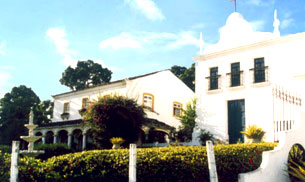
Morning visit the church of Our Lady of the Black’s Rosary, erected, probably, by Blacks in the XVI & XVII centuries and, the Sacred Art Museum in the Church of Amparo, which has a 2-metre high statue of Our Lady of Help, donated by the Princess Isabel. We will visit old mansions and constructions from those prosperous times. Lunch and a visit to Engenho Uruaé (Sec XVII), framed in our history with beautiful Mansions and Chapels. Afternoon treeking in the Atlantic Forest, attraction of the tour considered unmissable, sheltering 70 species of animals.
Day 5. (Thurs) – Goiana / Tambaba / João Pessoa.
After breakfast we continue on to our lodgings in Tambaba, a naturism beach on the Northeastern littoral. There are three beaches, but only one of them is governed by the ethics of the Tambaba naturists: one is only allowed to use it in the nude. Sexual relations are prohibited, as are photography, filming, the use by unaccompanied persons and gay couples. We enter another dimension where clothes, so coveted by us, become terribly disliked. Enjoy the agitated greenish sea – the way we came into this world.
Day 6. (Fri) – João Pessoa / Cabedelo.
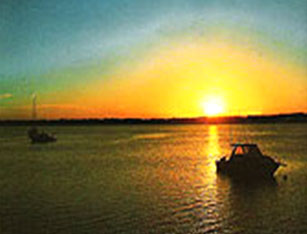
The third urban centre to be created in Brazil, João Pessoa registers in its history the presence of the French, Dutch and Portuguese. It is an important tourist centre in the Northeast, as besides having beautiful beaches, it is one of the cities with the most trees in the world. João Pessoa is the capital of the state of Paraíba. Ponta dos Seixas, next to White Cape, on Tambaú beach you will find the most easterly point of South America. Among its many baroque monuments, the Franciscan complex, which was started in 1589, stands out. Cabedelo owes its name to the fine-sand dunes which form on its beaches. From the colonial past, the church of Our guiding Lady (XVI Cent) and the Santa Catarina Fort stand out. We would suggest a swim from the The Island of Red Sand and the fantastic sunset.
Day 7. (Sat) – João Pessoa / Pipa / Natal.
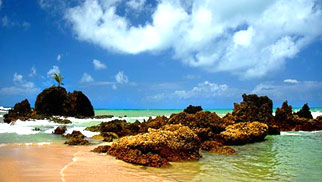
Pipa is a fishing village discovered by surfers in the 1970s. Pipa is one of the most frequented beaches in the state with bars and restaurants to liven the nightlife. The fishing village has incredible natural beauty with colourful half-submerged rocks, fine sands, and tepid transparent waters, not to mention the dolphins, which can be seen playing around the rocks. The spectacle starts while we are still on the road, near to neighbouring Tibau do Sul, with the unusual view of the lagoon emptying into the sea between the russet hillsides. The rectilinear splendour of Madeira Beach, the serene Bay of the Dolphins, where they can be seen at the end of the afternoon, and the tempestuous waves of Praia do Amor. The Nature Reserve of Quarry Beach Marine Turtles is an ecological sanctuary. Pipa seduces with its flavours, be it a succulent plate of seafood or a delicate crepe.
Day 8. (Sun) – Natal / City Tour + Pirangi.
Natal is situated on the banks of the River Potengi, close to its estuary on the Atlantic Ocean, a sandy area, with dunes and coves protected by a cordon of reefs along the beach which follow the coast. In 1597 a fleet commanded by Jerônimo de Albuquerque arrived in the estuary, with the mission of founding a town and a fort to secure Portugal’s possession and drive off the French who were trading with the Rio Grande do Norte Indians. The Three Kings Fort was started in 1598. A town, which in 1599 was baptized Natal (Christmas) in honour of its foundation day, was constructed one league from the fort. In 1633 the city fell to the Dutch and its economic progress died. The Tourist Centre, in the old gaol, contains artisan shops and a stage for folkloric spectacles. City tour and lunch in Pirangi along with the possibility of diving among the coral reefs. A stop to see the largest Cashew tree in the world.
Av. Hélio
Falcão, 530 - Boa Viagem - Recife/PE - Brasil - 51021-070 | PABX: (55) 81-3328.6007 - rbm@rbmturismo.com.br