| Day 1. (Sun) – Recife / Historic Tour. |
 |
 |
The years of Count Mauricio de Nassau’s government have gone down into history as the golden age of Dutch colonial rule. The talented politician and strategist transferred the seat of government from Olinda in 1637. A new city, Mauricea, sprung up, with paved streets, bridges and a level of urbanization previously unknown in Brazil. Two palaces crowned the labours of the administrator: Shipping, on the confluence of the Rivers Capibaribe and Beberibe, facing the sea, and Summer, outside the centre. The Governor-General surrounded himself with intellectuals, the painters Frans Prost and Albert Eckout being prominent amongst them. Then on to visit the Golden Chapel, the Synagogue, the Fort of Five Points, Sol and Aurora Streets, Brum Fort, the patio of São Pedro and Princesses’ Field. We suggest catamaran trip in Beberibe and Capibaribe rivers. |
|
| Day 2. (Mon) – Recife / Ingá / Areia / Cariri |
| Breakfast, then to Ingá, where we can find the principal Brazilian archaeological monument. This is a granite block 23m long (74’ 9”), covered with enigmatic symbols, carved by the Indians thousands of years ago. Then on to Areia. This small city, also known as Ouro Preto do Sertão (Black Gold in the Wilderness), boasts a row of 19th and early 20th Century houses, as well as “Engenhos” (Sugar Mills) from that period. Lunch in a city restaurant and then on to appreciate the scrub savannah, extremely exotic scenery. region. |
|
 |
|
 |
|
| Day 3. (Tues) – Cariri. |
 |
|
 |
|
Morning walk to “Saca de Lã”. Immense parallel granite slabs form a “pill” 15m high, which defies the imagination of those who try to imagine if their origin was natural or manmade. Today we obey the indigenous rituals when we eat: the main course will be “Bode no Buraco” (kid barbequed in an oven excavated in the ground). In the afternoon, we will visit granite formations in an area once inhabited by primitive tribes, hermits and visited by outlaws. We will watch the spectacular sunset from here. |
|
| Day 4. (Weds) – Cariri / Dinossaurs Valley / Brejo das Freiras |
| Morning to the city of Bravo where we will find granite mountains decorated with small lakes. These contrasting rocky formations form an attractive and exotic scene. Prehistoric and extinct animals – such as mastodons and sabre-toothed tigers – inhabited this region, leaving behind enigmatic relics. Return to the ranch for lunch and afternoon departure to lodgings at the Brejo das Freiras Hotel, a spa with therapeutic properties. |
|
 |
|
 |
|
| Day 5. (Thurs) – Brejo das Freiras / Canoa Quebrada. |
 |
|
Morning trip to visit the archaeological site of Lajeado de Soledade. We will find small “canyons” and caverns decorated with pre-historic paintings and carvings between 3000 and 7000 years old. Here fossils were found of gigantic animals from the Ice Age. Visit the Archaeological and Paleontological museum. Continue on to lodgings in Canoa Quebrada. |
|
| Day 6. (Fri) and
Day 7. (Sat) – Canoa Quebrada |
| Morning visit to Canoa Quebrada with its dunes of very fine sand, colorful faults extending like a wall facing the sea and warm waves.A place that surprises for the paradisiacal beauty. In 1650, the Portuguese navigator Francisco Ayres of Cunha stagnated in the coast of Canoa Quebrada. When it arrived in earth gave his broken arm to master Sebastião. It was then that the name Canoa Quebrada appeared. Canoa Quebrada is a beach located in the coast east of the State of Ceará to 166km of Fortaleza. This is a beach for those seeking entertainment (Broadway Street). Lunch (optional) under canvas on the coast and after passing an unforgettable day on the beach, a great variety of attractions among bars, restaurants and nightclubs. |
|
 |
|
| Day 8. (Sun) – Canoa
Quebrada / Ponta do Mel |
 |
|
After breakfast we continue on to Ponta do Mel (Honey Point), a semi-deserted beach half-submerged rocks decorating the calm waters, where fishermen clean their fish and the light orientates the boats. From the veranda of the chalets we can gaze out over the turquoise-blue sea that is always calm with a constant breeze. Ponta do Mel is a wilderness at the sea’s edge. And in the neighbouring port of Mangue, the combination of white sand, red earth and the semblance of the rosy dunes is enough to impress even the most travelled tourist. The rounded dunes form into an unforgettable tableau. “It is a natural viewpoint over the immensity of the White Coast”. A jewel hidden in a corner of Brazil. The inhabitants cohabit with technology – the extraction of petroleum and salt. |
|
| Day 9. (Mon) - Ponta
do Mel / Galinhos / Galo / Tourinhos / São
Miguel do Gostoso. |
| In harmony with the tides we continue our trip by buggy along the deserted beaches and through the coconut groves, coves cut into the dunes and fishing villages. Galinhos is only accessible from the sea or by buggy, becoming almost an island. It is well worth viewing the sea below from the heights, and, looking behind us, the immensity of the dunes. More to the front, the river cutting through the mangroves. One of the most beautiful stretches of this littoral is Tourinhos. |
|
 |
|
 |
|
| Day 10. (Tues) – São
Miguel do Gostoso / Maracajaú. |
 |
|
Today, also, we follow the rhythm of the tides, continuing our journey with sun, sea, transparent and warm waters, and fine sands with immense coconut groves. On Perobas’ beach we go diving among the corals in a calm sea with crystalline waters. Try the Moqueca de Arraia (Ray simmered in oil and pepper), one of the local specialities. Passing the Rio do Fogo (River of Fire), we arrive in Maracajaú, the new star of Potiguan tourism. The beach is lovely, a cove lined on the right with coconut groves. Try the Cocorote, a biscuit made with flour and coconut, then on to our lodgings in Natal. Today is a day for “Forró with the tourist” at the Tourist Centre. |
|
| Day 11. (Weds) – Natal
/ Jacumã. |
The beach 32kms north of Natal offers optimum bathing conditions as the sea is calm and clear. Jacumã also offers a complex of fixed and moving white and golden sand dunes where tourists can have an emotional ramble and also (optional) visit the Jacumã Lake set amongst the dunes where the famous sports of “aerobunda” and skibunda” (seated boarding) can be enjoyed. There is an excellent menu to choose from at the Naf-Naf restaurant in Jacumã, on the coast. This is the most charming place on the Northern Littoral!!
We recommend a buggy trip through the Genipabu dunes. The circuit includes stops to bathe in the waters of lake and in natural pools, and a camel ride through the dunes.
|
|
 |
|
| Day 12. (Thurs) – Natal
/ Pipa / João Pessoa. |
 |
|
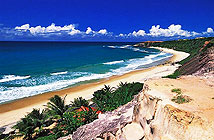
Morning visit (08h) Pipa, a fishing village discovered by surfers in the 1970s,is one of the most frequented beaches in the state with bars and restaurants to liven the nightlife. The fishing village has incredible natural beauty with colourful half-submerged rocks, fine sands, and tepid transparent waters, not to mention the dolphins, which can be seen playing around the rocks. The spectacle starts while we are still on the road, near to neighbouring Tibau do Sul, with the unusual view of the lagoon emptying into the sea between the russet hillsides. The Nature Reserve of Quarry Beach Marine Turtles is an ecological sanctuary. |
|
| Day 13. (Fri) – João
Pessoa. |
| Morning visit the Paraiban capital, complete with antiquities such as churches, museums, cultural centres, parks and old buildings. The Santa Rosa Theatre in Pedro Américo Square is one of the four oldest theatres in Brazil (1888). The St. Francisco Cultural Centre (1589) took almost 200 years to complete. Its Baroque group is made up of the church of St. Francisco, the convent of St. Antônio and the Popular Culture Museum, which has permanent exhibitions on folklore, xylographs and sacred art. There will be a visit to the Ilha de Areia Vermelha (the isle of the red sand) for bathing and to see the sunset on the Jacaré beach. |
|
 |
|
| Day 14. (Sat) – João Pessoa / Igarassu / Itamaracá / Recife. |
 |
|
Established approximately in 1535 by the noble Duarte Coelho with the name Village of Santa Cruz and raised to the category of village in 1564, Igarassu preserves the fascinating church of the Saints Cosme and Damião, the oldest church in functioning (1535) and the third Franciscan Convent installed in Brazil, which keeps a fascinating set of panels spotted oil of century XVIII. Paintings tell us a little bit of the city’s history. People of Igarassu knew to keep its treasures of the past that today enthusiasm tourists, curious, historians and visitors from all the continents. Igarassu is located in the region where the first exploration during the Portuguese colonization took place. We will visit the famous Itamaracá Island and the Orange Fort, from where we can cross over to Coroa do Avião to enjoy bathing. |
|
| Day 15. (Sun) – Recife / Olinda. |
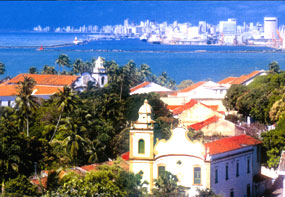
| Olinda, the Capital of Pernambuco until 1937, possesses important colonial architecture and because of this, in 1982, UNESCO declared its historic centre a Cultural Heritage of Humanity. The foundation of Olinda dates from 1535. The original small town was constructed by Duarte Coelho Pereira, the donee of the Captaincy of Pernambuco, and became Capital. A walking tour of the historic centre, where the Heights and Church da Sé (1537), the old slave market, the steep street to and the convent of São Francisco (1585), the Episcopal Palace and the São Bento Monastery, which ran the first ever law course in Brazil, all stand out. | |
 |
|